
No matter where you might roam across the United States (this one’s for you World Cup visitors who might have toted along a fly rod in addition to your football kit), you’re going to be within reach of an excellent fly rod target. Carp might be America’s least-appreciated game fish, but the hardy Asian imports can and do live just about anywhere in the US. Visitors from Belgium traveling to Seattle for next week’s match with Team USA — who might not be terribly interested in the city’s salmonid offerings — can find carp swimming alongside sea-run cutthroat trout in Lake Washington (hint: look for sizable carp in the warmer, shallower waters at the north end of the lake).
That’s pretty good advice this time of year just about anywhere in the country. With the spring spawn over, the shallows of lakes, ponds, and even the slack waters of our nation’s best trout rivers are crawling big, surly carp busy gobbling down everything from damselfly nymphs to bread crusts tossed into the water, meant for gregarious park ducks. While these hand-fed and largely domesticated fish are hardly a fly-rod challenge, there are carp fisheries that offer up plenty of opportunity and the need to level up your fishing game. And, if you’re lucky, you can see some of America’s lesser-known fly-fishing destinations while testing your mettle against the smartest fish in the water.
Here in the West, the sloughs and backwater bays of the Snake and Columbia rivers are ideal for fly rodders looking for carp. And, on both rivers, whether you’re plying the shallows of Walcott Reservoir near the small Idaho farm town of Jerome, or sight-casting to 15-pound cruisers in a holding basin outside of Kennewick, the fish this time of year are keyed on one very predictable critter: crawfish.
These crustaceans, often just as invasive as the carp themselves, are plentiful in the warm slack waters of the Northwest’s rivers, and carp are notorious for rooting through the muck to find them. But it’s not a matter of just tying on a Woolly Bugger and finding the right strip speed — although a size 8 olive or brown Woolly Bugger is a really good starting fly.
Crawl the fly
Just as with any fly meant to imitate a natural food item for any fish, it’s best to fish your crawfish pattern for carp in the most deliberate fashion you can imagine. I call it the “crawfish crawl” and I only speed up the retrieve if I’m sight-casting and I see that I’ve garnered some interest from a cruising fish. When blind casting — and, in our mucky backwaters turned up by feeding fish, this isn’t unusual — the idea is to slowly bring the fly along the bottom, just as a feeding crawfish might travel across the mud on its own.
While fishing with a serious carp addict in the sandy shallows of CJ Strike Reservoir, an impoundment of the Snake River in southwest Idaho, some years back, I was told the crawling tactic is an absolute necessity for post-spawn feeding carp. “You’ll find more carp this way,” he explained, as he literally used his left pinky finger and thumb, rotating them back and forth in a fishy “hang loose” motion to slowly retrieve his fly line. “And you won’t be interrupted by as many bass.”
Such is the irony of carp fishing. For most fly fishers, the lively smallmouth and largemouth bass fishing found in the backed-up reservoirs of the Snake and Columbia are much more preferred fly-rod targets. But for die-hards chasing carp, the equally invasive bass are opportunistic and they, too, dine heavily on the dark crustaceans that carp tend to prefer this time of year. Once they’re off the spring spawning redds, however, the bass are more likely to chase streamers that are stripped a bit faster than a crawl.
The flies
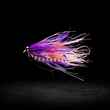
I wasn’t kidding about the Wooly Bugger. This easily tied streamer is a solid base fly and, in olive, dusky orange, and brown, it’s an excellent crawfish imitation. That said, I do tend to “dress it up” a bit. My version of the Carp Crawler is a small, slightly altered ‘Bugger with a green glass bead for a head, and I tie in a pair of pink, orange, or yellow rubber legs to the shank before I tie in an olive marabou tail. The body is tightly spun olive dubbing secured with a very thin strand of gold tinsel, and then I simply palmer an olive, brown or rusty hackle feather up the body to the glass bead.
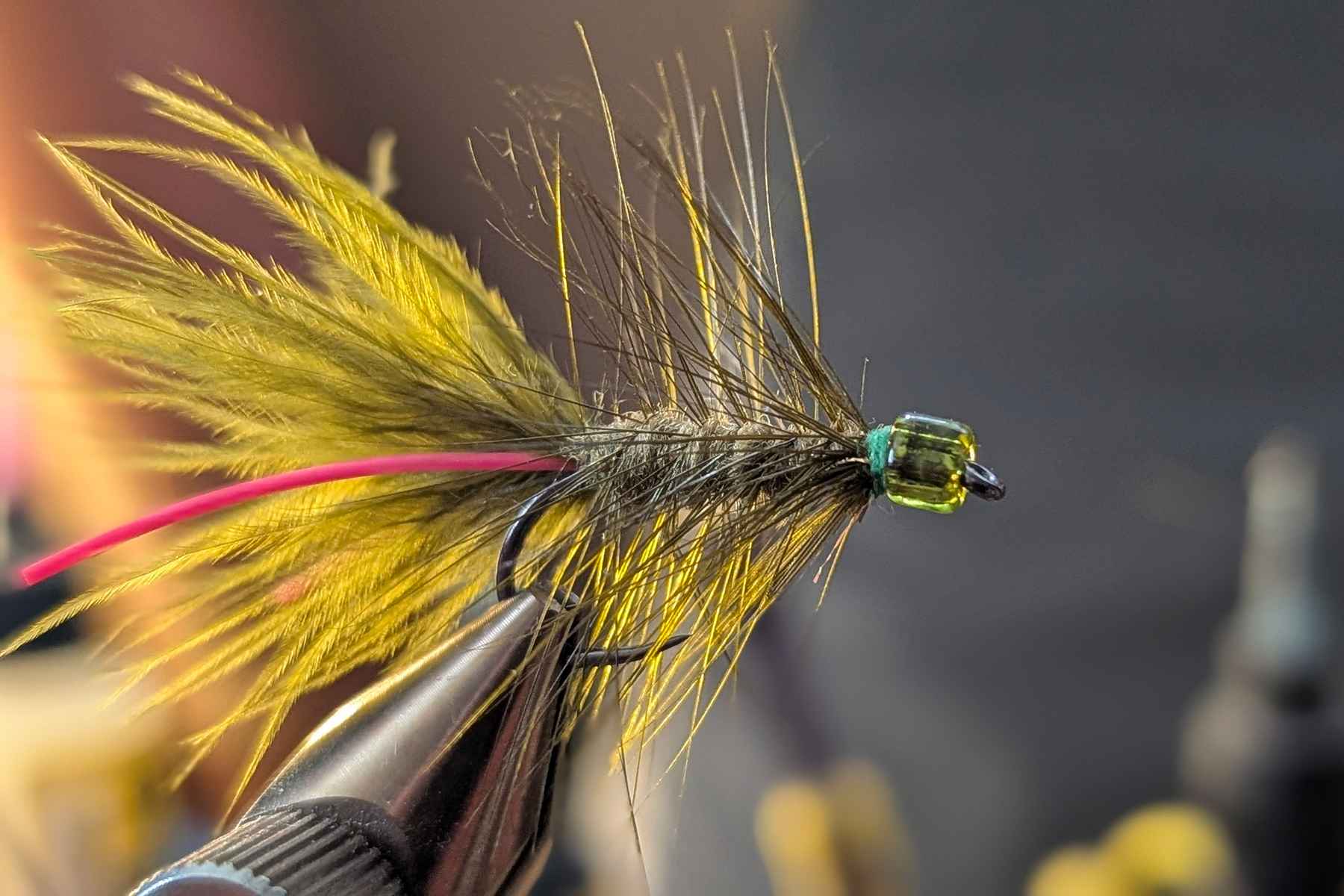
And when I say small, I mean like a size 10 or a size 8 — and I almost always use big nymph hooks rather than long-shanked streamer hooks. The idea is to get the fly to the bottom quickly, and long-shanked hooks use more tying material (and have more water resistance). The short-shafted nymph hooks, armed with a shiny glass bead, tend to dive a bit quicker. And, with the pink or orange rubber legs that in some abstract way serve to imitate the colors and wiggle nicely after a short crawl, the fly still stands out. When it’s crawled, even ever so slowly, it leaves a little dusty trail for feeding carp to follow. And the bead? When a small crawfish tucks its tail to swim, its scaled back is shiny. When you’re sight-casting and retrieving the fly, that little bit of shine helps the angler, too.
Even better? In a pinch, this fly is a solid dragonfly or damselfly imitation in the spring, before the crawfish come out in numbers and when early-arriving males pop up into the shallows to see if any of the big females are ready to party yet.
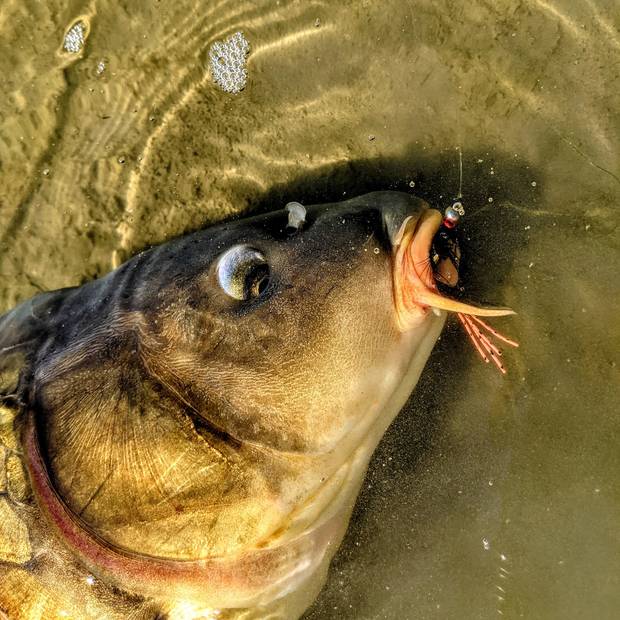
This unremarkable little pattern has proven to be a solid carp catcher, and it’s a great fly to crawl along the muck, where the these sometimes-massive fish are looking for more subtle food offerings than something tied on a size 2 shank with an articulated back half.
That said, other slowly-fished flies work well, too. When I was first starting my “carp journey” some 25 years ago, I defaulted to saltwater flies, like small Gotchas, Crazy Charlies and even Clousers. These patterns likely worked based on their simple ability to creep along the bottom, and, let’s face it, there are days when fly casting to carp in the shallows can look a lot like casting to bones on the flats.
Be patient
One of the biggest hurdles fly casters searching for carp in the shallow impoundments and sloughs here in the West have to overcome is the natural desire to cover water. Certainly, moving about can put you within reach of cruising carp, but, just like bones or permit, the slower and more deliberate you are, the more likely you’ll be to find fish moving around you. I’ve had dozen-fish days where I might have taken fewer than 100 steps in the shallows and instead waited for carp to come to me as they hoovered over the flats looking for hapless crustaceans.
But, like bonefish, carp will “mud” and create a general patch of murky water when they find a crawfish honey hole in the shallows. This is a much easier scenario for anglers who like to walk and wade and the necessity for stealth isn’t nearly as vital. Remember, though, that these gatherings can be short-lived, and that spooked or panicky carp give off a pheromone when they turn on the gas and flee. That’s why you’ll often see quick puffs of mud and general chaos when just one carp figures out that you’re in the water with them.
Move less. Cast more. Use those polarized glasses and watch for nervous water, just as if you were on some white-sand Caribbean flat waiting for the next school of bones to swim by.
Final word
All across the country, carp fisheries are underutilized, and they offer a challenge that most fly fishers aren’t interested in facing down. Here in the West, with high-country and tailwater trout on the menu during the summer months, and with smallies turning up in warmer rivers (like the Snake and Columbia, unfortunately), carp are often overlooked. But, if you want to fool a heady fish and enjoy a fight reminiscent of a saltwater battle with a bonefish or a redfish, look closely at the froggy waters of the West’s great rivers. Carp swim there. Carp eat there. For enterprising anglers, these fish represent an opportunity that shouldn’t be ignored.



Comments