
Dr. Robert Behnke, the late and eminent fisheries biologist who literally wrote the book on trout taxonomy, was a matter-of-fact kind of guy. In my early years as a newspaper journalist, Behnke was on my speed dial as I navigated the fascinating and complex world of native trout classification, particularly the names and biological assets prescribed to the West’s cutthroat trout. He was very good at describing the complex genealogy of trout, both native and invasive.
But we never had an extended chance to really talk fishing, which he was quite fond of doing. We did have one quick conversation about a decade ago, as I described a trans-continental trip up through Canada and Alaska. I mentioned that I’d be fishing for everything from northern pike to coho salmon, and he zoned in on the cutthroats of southern British Columbia and the Arctic grayling that were — and still are — the prominent inland salmonids that range from central BC all the way north to the Arctic.
“Use purple flies,” he told me. “That indirect northern sunlight makes a fly’s silhouette very important, but trout and grayling can see colors from the blue and violet side of the color spectrum much better than other fish.”
I took the advice to heart, and it paid off. And, it turns out, grayling and cutthroats aren’t the only fish that are attracted to the pop and contrast that purple brings to flies. The northern pike on my journey north definitely showed an interest in purple or blue-violet flies, and even the lake trout in the shallow lakes of the southern Yukon seemed to prefer some blue or purple in the streamers that pulled them off the bottom. The latter worked particularly well when coupled with chartreuse or orange. As Behnke noted, colors from the blue-violet spectrum tend to be more visible to trouty eyes.
Though it may not be intentional when a guide fishing a Green Drake hatch ties on a size 12 Purple Haze – the fly just works. But there’s a reason it works. Trout simply see it better. Now, whether or not that translates into an actual eat is likely still up for debate.
How trout see color
To understand how trout see colors, it’s best to first understand how a trout’s eyes work. Just like in humans, a trout’s eyes use rods and cones to interpret visual images. In both people and trout, rod cells bring black and white images to the brain — this is important in low-light scenarios, or when dealing with contrast (say, a dark silhouette against a bright, sunny sky). Cone cells capture colors because they contain photo-sensitive pigments that absorb specific wave lengths of incoming light. Humans have three types of cone cells. Trout have four.
That fourth set of cones? You guessed it. It helps trout see colors that we don’t process nearly as well, particularly in the blue-violet range of the color wheel. That’s the simple explanation for why purple flies grace nearly every reputable box of flies, dry or otherwise.
More than just color
While that’s the convenient answer to the purple-fly question, it’s not just about tying on a Purple Haze in the midst of a March Brown hatch to catch more fish. The old “match the hatch” adage is every bit as important as ever. Rather, a good time to go with a purple fly — be it the venerable Purple Haze with the parachute hackle or an Egg-sucking Leech on the swing during the brown trout migration — should probably be determined by what anglers are seeing on the water. In other words, if there’s an obvious caddis hatch happening, a color-appropriate imitation of crippled caddis is going to be a better choice than a caddis tied with purple dubbing.
But when seemingly nothing is happening, or if it’s a bright sunny day, and the PMD hatch is sporadic, a Purple Haze might be just the ticket. Giving trout something a bit different that they can really see matters, and the proof is in all those fly boxes.
Patterns for purple
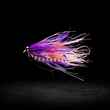
We’ve talked about the Purple Haze, which is really just an Adams tied with purple dubbing and a bright white parachute wing (the latter is for us three-coned anglers and not so much for the trout). But purple is finding its way into a number of dependable patterns that have proven very effective for trout. Here’s just the short list:
- Chubby Chernobyl — If you’ve fished with a guide during hopper season, or anytime of the season in Patagonia, you’ve likely noticed really big Chubby Chernobyl patterns tied with flashy purple dubbing. These flies not only give the trout a big silhouette against a bright sky, but, in lower light, where anglers might not see the blue-violet slice of the color wheel, these flies stand out to trout.
- Stimulator — This might be the most important big-bug imitation fly fishers tie. It can be a big caddis or a middling stonefly. Tied in purple, it’s an attention-grabber that possesses both the correct silhouette and the materials that trout see far better than humans do.
- The Purple Nurple. This dry fly is in the Purple Haze family, which is meant to say that it’s in the mayfly imitation family. Tied parachute style with violet and purple thread or dyed feather quills as the body, it’s tied with a foam wing that, like the white Antron used for the Purple Haze, makes it easier for anglers to see on the water. Tied is size 18 or 20, the Purple Nurple is a particularly good fly pattern to have on hand when baetis are — or should be — on the water.
- Purple Perdigon. Ah, the fast-sinking immigrant from the hallowed halls of the Euro-nymphing crowd. Often, these beaded and epoxied nymphs are tied with “hot spots,” and, often, that hot spot registers on the blue-violet side of the color wheel, and can be anywhere from hot pink to dark purple.
- Egg-sucking leech. The Wooly Bugger with the pink or orange bead for a head is a go-to pattern for steelhead and salmon anglers, but it’s a solid pattern for brown, rainbows, and even cutthroats in inland waters. In smaller versions, it’s an excellent fly for bigger Arctic grayling that tend to hold deeper, and for predatory char, like lake trout, bull trout, and Dolly Varden.
Do other fish see purple better, too?
Not all fish have that fourth set of cones that’s uber-sensitive to ultraviolet light and shades of colors on the blue-violet spectrum. That’s a trout thing. Northern pike and muskies, for instance, don’t have a set number of rods or cones, but have eyes that contain rods and then single-cones and twin-cones that help these predators see contrast much better than they see color. And darker colors offer more contrast in dark, deep, or stained water, so a purple fly is a solid choice when going after these toothy fish.
That makes sense to me, as an avid pike angler. When these predators are deeper and the water is darker, or when the outside light is less direct and not directly overhead, darker flies tend to work better because they play off the Essox eyes that hone in on contrast. I remember one night at Royal Wolf Lodge in the Bristol Bay drainage, after a day spent chasing big rainbows using long, purple streamers. The lodge’s chef and I took a small skiff out on the lodge’s home lake in search of pike for the next day’s appetizer, and as the sun dipped low in the late evening sky, I tied on a dark purple Slumpbuster that I thought was a solid imitation of the leeches that are common in boreal lakes of the north. We caught a number of nice pike on that fly, and, while it did likely imitate the lake’s leeches, it was probably the contrast the dark fly offered that appealed to the toothy predators that particular evening.
Of note, my personal best northern pike, that stretched the tape 47 inches, was caught on a size 2 purple ‘Bugger.
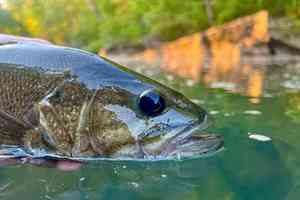
Bass anglers might never need a purple fly, because bass have dichromatic vision — their eyes only possess two types of cones. The first is a green-sensitive single cone, and the second is a red-sensitive twin cone. The rods in a bass’ eye are really good at pulling in light, so they can see pretty well in dark water. But darker colors, like brown and purple, only show up as grays or blacks — bass vision has been described as similar to human vision, only through a yellow filter.
In other words, fly fishers looking to appeal to bass don’t need to include purple in their patterns — to bass, a purple ‘Bugger will look like a black ‘Bugger.
Final word
It’s no coincidence that you’re seeing more purple flies in guide boxes and fly boxes, particularly on trout streams where the intended target can see colors on the blue-violet spectrum better. It pays to tie even the most traditional trout patterns with a touch of purple — the color stands out to trout.
For other fish, well, purple is … hazy. While it might improve a fly’s contrast in boreal lakes where northern pike tend to hang out, it’s likely no better than straight on black. And fish in the black bass family can’t separate purple from brown, so it’s not a necessity for tyers concocting bass bugs at the vise.
But, if you’re a trout angler, and you’re on the fence about purple, know this. It works. And if it works, make sure your fly box has the color purple in it.




















Comments
Richard Darling replied on Permalink
I fished Steelhead in northern BC for 35 years, primarily on the Notice and Bullet systems. They loved the purple patterns. My go to was a purple skunk on a six hook. I still smile at the take of the Steelhead on on subsurface pattern. I was lucky enough to live on the river and fish daily. The Steelhead in these systems also loved the a skated dry. I still dream about it.
Chuck Stranahan replied on Permalink
I'd love to talk color theory with you, Chris, maybe sitting on a streamside log between hatches.
Light polarizes and refracts when it enters water. The light bouncing off the side of a fly in the surface film looks different underwater to a trout than it does to us, looking at the same fly in air where light diffuses. Start there.
Much to talk about. It'd be fun.
Chick Woodward replied on Permalink
I tied some bonefish flies with brown uv body fuzz that glowed purple in the sunlight. Everyone laughed at them when they saw them, but they outfished the regular brown ones.
Pages