
The county cop had me dead to rights. He knew it, and I knew it. Or at least I knew it when, as he passed me heading east on the two-lane highway (I was heading west), I glanced at my speedometer and realized I was humming along somewhere north of 65 miles per hour. The speed limit, of course, was 55.
Yeah, I was screwed.
His party lights began to strobe; I said some bad words. He whipped his squad car around in a Bullitt-worthy U-turn, and I pulled onto the shoulder.
The deputy proved to be an affable guy of medium build who looked to be in his 30s. His uniform, like his hair, was light brown. The grip of his service weapon was jet black.
After checking my license and registration—and telling me he’d clocked me doing 68—he asked, “Any particular reason you’re in such a hurry, Mr. Davis?”
“Um, I’m going trout fishing.”
“Trout fishing,” he repeated, as if he needed a second or two to wrap his mind around the concept. “Where?”
Not the time to be cagey, I figured. “The Tomorrow River in Portage County. Near Nelsonville?”
“Yeah, I know where that is,” he nodded. “Good place to fish?”
“It can be,” I shrugged. “You never know.”
“Well,” he said, “I’m letting you off with a warning. Watch your speed in the future, OK?”
“Yes, sir. Thanks.”
Feeling as if I’d dodged a bullet—and trying hard to keep a light foot on the gas —I pulled into the streamside parking area a little less than an hour later.
Happily, it was empty. The Tomorrow at Nelsonville is on the radar of every trouter in the central Wisconsin Sand Country, so to have it to myself on a lovely afternoon in early May—prime time for the black caddis hatch—was an unexpected stroke of good fortune.
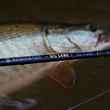
My luck held on the water, too. This is tough, fairly technical fishing: tight quarters that typically require well-placed upstream casts, puzzlingly tricky currents, picky fish that can be despairingly hard to fool. But everything went right, for a change. I knotted a gray Elkhair Caddis in size 18 to a leader tapered to 6X, took the mucky trail through the skunk cabbagey woods to the first bend downstream, and found a fish rising regularly in a spot where I had a puncher’s chance of putting a decent drift over him. He ate on the third cast, and after a sprightly battle proved to be a regulation Sand Country brown: 12 inches or so, gorgeously colored, perfectly proportioned. The kind of brown trout James Prosek would paint.
The hatch was ramping up; trout were starting to work both upstream and down; I felt good, really good, about my prospects. Given the day’s precarious start, I was beginning to wonder if I might have snatched victory from the jaws of defeat. Or, as my dad liked to say, if I’d made chicken salad out of chicken shit.
Well, without putting too fine a point on it, it was more like the other way around. Which is to say, the wheels fell off, comprehensively. And, for the rest of the afternoon, irreparably. I could get the fish to eat, but no matter what I did I couldn’t get them on the hook! (And yes, I checked to make sure there still was a hook.) It was frustrating, maddening, perplexing, embarrassing, ego-crushing,
soul-hollowing—round up the usual adjectives we trot out when things go south.
I suppose I should have been grateful for not getting a speeding ticket, along with the attendant points, paper trail, etc., but I wasn’t much in the mood to look on the bright side.
Here’s the thing, though: It seems like I have exactly one day like this every spring during the black caddis hatch. Meaning, a day when the hatch is good, the fish are active, I can get them to eat … but I can’t get the s.o.b.’s on the hook for love or money. It’s just weird. And what makes it all the weirder is that the next time I go everything will invariably be more-or-less back to normal. I’ll miss some strikes, sure, but the percentage will be well within acceptable parameters. What the hell is going on?
In search of answers, I asked two of the most thoughtful, insightful, and experienced fly fishermen I know if they’d be willing to weigh in on the matter: Todd Tanner and Nick Voss. A familiar presence in the pages of Hatch since Hatch was hatched, Todd, who makes his home in Montana, is a former Henry’s Fork guide, a widely published writer, and the founder of The School of Trout, a.k.a., the MIT of angler education. Nick, a renowned teacher who serves as Head Guide for the Driftless Angler in southwestern Wisconsin, is on the water virtually every day of the season, not only putting his clients on fish but imparting skills and knowledge they can use wherever they fish.
“We all have days like that,” Todd mused via email after I’d laid out the scenario (caddis hatch, small flies, mostly upstream casts). “I have one or two per year, on average, and I suspect they’ll remain one of life’s small mysteries. If I had to pinpoint a reason, though, I’d look at one of these possibilities:
1. Operator error. We all have days when we’re just not performing as well as we usually do.
2. An issue with the fly itself—hook size, hook shape, bent hook, defect in materials or construction, etc.
2. Poor hooking angle. It’s usually harder to hook fish that are downstream of our position as we have to wait for them to close their mouths before we set the hook. That said, casting straight upstream is problematic as the fish tend to hit the leader when they rise, which moves the fly and limits hook-ups.
4. Bad luck.
5. Small fish, which are often harder to hook than bigger fish.”
Todd added, “I also think that failure can breed failure, in that we try harder/get a little stressed/put more pressure on ourselves when we don’t perform as we expect ourselves to. Which definitely doesn’t help!
“And my personal experience is that I’ve had as many of these kinds of days over the years with mayflies as I have with caddisflies.”
I caught up with Nick Voss as he was driving home on the second-to-last day of the Wisconsin trout season. (He reported that his clients had done well fishing ants and beetles.)
“When you’re fishing upstream and you miss a rise,” he said, “there are generally three things that can come into play. One is a problem with the hookset, which typically boils down to striking too soon. If I can’t get my clients to wait a couple of beats before setting the hook—‘God Save the Queen’ and all that—I’ll teach them the old steelheader’s trick of keeping about ten inches of loose line between the reel and the ‘pinch’ finger. When the fish strikes you let
that loose line ‘slip’ as you lift, delaying the hookset. It sounds crazy, but it works.
“Another reason for missed strikes, especially with caddisflies, is that what looks like a rise is actually a refusal. When that happens I like to go to something more ‘emerger-y’ that rides lower in the surface film. Another option in these instances is to trail a number 18 Pheasant Tail, or something similar to that, as a dropper.
“Finally, whenever you’re using really small flies, meaning sizes 18 and smaller, the hook’s so tiny that sometimes, even when your timing’s on, the hook just doesn’t ‘grab.’ What I do, if I can, is bend the hook so that it’s slightly offset. This creates more ‘bite’ and gives you a better chance of hooking up.” (Just as a point of information, Nick said that in his experience Tiemco hooks stand up to this hack pretty well.)
Nick wrapped up our conversation with this observation: “It’s human nature to react: You see a fish eat, you want to jerk back—and you pull the fly out of the fish’s mouth. You have to remind yourself to slow down and just lift the rod. As I tell my clients, ‘Pretend you’re the Statue of Liberty.’”
Sounds like good advice to me, along with all the other tips, both practical and philosophical, these two master trout fishermen have to offer. Now if I can only remember to put them into practice! Still, I can’t help but be reminded of this mossy old chestnut from the world of wingshooting:
To hit is history … To miss is mystery.




















Comments