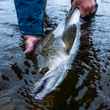
Sometimes the enemy of good isn’t evil. Sometimes the enemy of good is perfect. This may be the case on Buffalo Creek, a wild trout stream that runs through the Absaroka-Beartooth Wilderness of southern Montana before crossing into Yellowstone National Park. Buffalo Creek is a tributary of Slough Creek and, eventually, the Lamar River. It’s also been identified as the source of the non-native rainbow trout that have persistently been showing up in both Slough Creek and the Lamar. The invasive trout were first planted in Buffalo Creek in 1935, according to Montana Fish, Wildlife and Parks.
Slough Creek is one of the last great trophy Yellowstone cutthroat streams in the fish’s native range, and the Lamar is the largest tributary to enter the lower Yellowstone River inside the national park. Over the last decade or so, rainbows have been turning up in both the creek and the river.
That’s problematic. Rainbow trout and cutthroat trout can mingle on the redds during the spring spawning season, and the resulting offspring is a fertile hybrid often called a “cuttbow.” Over time, the rainbows and the hybrids chip away at native cutthroat trout genetics, until they’re gone altogether.
To combat the ongoing invasion of the rainbows, the U.S. Forest Service and MFWP want to remove the non-native fish from Buffalo Creek from its confluence with Slough Creek upstream some 46 miles to Hidden Lake. The method of non-native trout removal — poisoning the watershed a chunk at a time with a piscicide like rotenone — has proven effective for decades.
In the proposed plan, not only would the removal of rainbows halt the invasion of the non-native trout in Slough Creek and the Lamar River, the proceeding relocation of Yellowstone cutthroat trout would give the fish miles and miles of new coldwater habitat. One of the reasons the two agencies want to pull this project off is because native fish in the West aren’t gaining habitat, and they’re particularly not gaining habitat that can serve as climate refugia in a rapidly warming world.
Good, but not perfect
Generally speaking, it’s a good plan. But, if you ask the non-profit group Wilderness Watch, it’s deeply flawed and hardly perfect. Earlier this month, the group filed a lawsuit in opposition of the plan, noting that the removal process involves a poison that not only kills fish, but also kills aquatic insects, amphibians — anything that breathes with gills.
Additionally, the group says in its complaint, the removal effort would involve “a decade’s worth of helicopter landings plus the use of other motorized equipment” to get the job done.
Finally, Wilderness Watch opposes the plan because, above a series of waterfalls on Buffalo Creek that serve as a fish migration barrier just north of the national park boundary, the creek, before it was stocked with rainbows in 1935, was historically fishless.
“Our lawsuit challenges (USFS/MFWP) managers’ plans to continue intensively engineering the aquatic ecosystem through poisons and the exchange of one non-native stocked fish species for another,” a statement found on the group’s website reads. “We assert in its complaint that both the ends and the means of the Forest Service’s project violate the provisions of the Wilderness Act, which provides protection to this area.”
Some perspective
Yellowstone cutthroat trout might be the signature native fish of the interior West. This is the fish that, until invasive lake trout were found in Yellowstone Lake some 30 years ago, was among the healthiest of the West’s native trout. Yellowstone cutts still had healthy and intact big-water habitat with access to abundant cold-water spawning streams. And they were delivering a world-class experience to recreational anglers who traveled to Yellowstone National Park from all over the world for the chance to catch one.
But, when those invasive lake trout were discovered in the early 1990s, the writing was on the wall. By 2010, the predatorial char had eaten their way through the bulk of the lake’s native fish — some 99 percent of the lake’s spawning Yellowstone cutthroat trout were gone.
Thankfully, thanks to millions of dollars and thousands upon thousands of hours of thankless work spent netting lake trout from Yellowstone Lake, the National Park Service has been able to bring the lake’s native fish back from the brink of a very dark fate. The work isn’t done — and very likely never will be. Yellowstone Lake will always be home to lake trout, and that means the Park Service will always be in the lake-trout removal business.
Even with a functionally healthy Yellowstone Lake, Yellowstone cutthroat trout today occupy only 10 percent of their historic range. Countless examples exist today that highlight the thoughtlessness exhibited toward native trout as the West was gentrified. Non-native fish were rampantly stocked over native trout. Mine tailings were allowed to leach into trout streams. Agricultural development turned trout streams into irrigation straight-pipes. Rivers were chronically overfished. Today, rapidly warming water associated with global climate change is providing one more knock on the head to one of our most-treasured native trout.
Frankly, we’re lucky the fish exist at all.
What’s perfect in an imperfect world?
Wilderness Watch is absolutely right. If the plans put in place by the Forest Service and MFWP come to fruition, non-native Yellowstone cutthroat trout will swim the waters of Buffalo Creek above a naturally occurring migration barrier. That barrier, before the rainbows were unceremoniously dumped into the creek almost a century ago, kept Buffalo Creek devoid of fish.
But what of the intent of the plan? Is it imperfect to actively seek out appropriate habitat for a species that is missing from 90 percent of its historic habitat? Is it really worth a district court lawsuit to fight a plan to improve the standing of a fish native to the region, but non native to 46 miles of small-water habitat?
And … honest question, here: do we have time to nit-pick the Wilderness Act and determine the short-term impact from the use of pisccides and helicopters when, according to biological forecasts, we stand to lose half of the livable habitat for wild trout over the next half century?
“This project is an essential piece in Yellowstone cutthroat trout conservation work,” said Mike Thom, Gardiner district ranger for the Forest Service when the project was first announced in April 2022. “The Custer Gallatin National Forest and specifically portions of the Absaroka Beartooth Wilderness is poised to create secure cold water refugia and strongholds for the long-term sustainability and success of Yellowstone cutthroat trout. This is one of those prime opportunities working jointly with Montana Fish, Wildlife & Parks to benefit the natural characteristics of wilderness with native fish communities critical to our ecosystem.”
Note the inclusion of the term “cold water refugia.”
Let a good idea be good, even if it’s not perfect
One of the most troubling aspects of the environmental movement among average Americans is the perception that those who practice environmentalism are absolutists. While there are myriad examples disproving that perception, all it really takes is one example where a well-meaning non-profit can offer enough fodder for the “See? I told you so” crowd.
No, Buffalo Creek is not historically a Yellowstone cutthroat trout stronghold. But for the better part of a century, it’s been home to an introduced population of rainbow trout, which aren’t native either.
The plan to remove the exotic rainbows from Buffalo Creek should be celebrated. The plan to replace them with significantly less exotic Yellowstone cutthroat trout is a good one and Wilderness Watch should pay its attorneys to tackle more important issues facing wild country in the West.
No, it’s not a perfect plan. But it’s pretty damned good.