
For the first time ever, Team USA claimed the gold-medal spot on the podium at the 2026 FIPS-Mouche World Fly Fishing Championships. The win for the group of American fly fishers marked the end of a dynasty of sorts — up until last week, Team France was the three-time defending champion. For the cherry on top of the team win, North Carolina angler Michael Bradley took home the individual gold at the Sept. 13-18 tournament based in Idaho Falls, Idaho.
Over the course of the event, anglers from 21 countries competed on waters in three states throughout the so-called “Golden Triangle” of Idaho, Wyoming, and Montana. In the event, in which lower scores are better, Team USA notched 159 finishing points, finishing ahead of France (175) and Belgium (187). In total, the winning team’s five anglers landed 472 trout over 20 centimeters (approximately 8 inches). Prior to this year’s top finish, the best Team USA finishes at FIPS-Mouche World Fly Fishing Championships included a silver-medal finish in 2016, and bronze-medal results in 2016, 2024, and 2025.
“The result is the culmination of years of work by team members past and present,” said team captain Pat Weiss of Port Matilda, Pennsylvania. “The tournament was full of ups and downs but ended with the fulfillment of a dream.”
Where did the anglers fish?
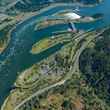
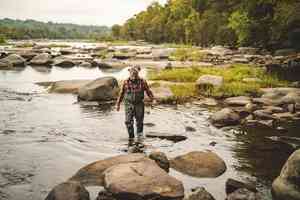
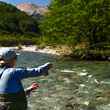
The anglers at the 2026 event fished waters in all three states. In Idaho, anglers fished the Teton River, the Henry’s Fork, and Sheridan Lake. In Montana, anglers fished Hebgen Lake; in Wyoming, the Greys River was used as a venue. Each body of water is broken up into “beats,” some of which are admittedly less prime than others. That’s where the team aspect really comes into play – one day, an angler for any given team might get a stellar beat on the Greys with lots of rifles, deep tailouts, and good structure. The next day, their teammate might have be forced to collect fish points from a less-appealing beat with fast water, little structure, or poor holding water. Anglers arrived early to Idaho Falls to inspect each beat and to practice ahead of the competition.
“We all wanted a gold medal, but we were working to make it happen for each other, not just ourselves,” said Team USA angler Mike Komora of Bellefonte, Pennsylvania. “This week our team worked together extremely well. That teamwork and mentality is the reason we took first place.”
Indeed. Consistent fishing across the board is the reason the American team finished ahead of its competition. Under the FIPS-Mouche scoring system, steady fishing results from all five anglers on a team is more important than one angler having a fantastic session one day, and then blanking (catching no fish) the next day on a really tough beat. How so? The scoring system rewards teams that fish well over five straight days.
How the scoring works
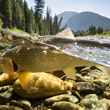
First, there are fish points. A fish that is 20 cm long is worth 100 points. Then, anglers are awarded an additional 20 fish points for every centimeter a fish measures over 20 centimeters. For example, a brown trout that measures 40 centimeters (just shy of 16 inches) is worth 500 fish points (100 points for 20 centimeters, plus 400 points for the additional 20 centimeters). At the end of a day’s session, the angler with the most fish points is assigned “placing points” among his group. The angler with the most fish points gets one placing point. The angler with the second-highest fish-point tally gets two placing points. Three placing points go to the third-place angler, and so on, all the way to the angler who finishes last and gets 21 placing points. The lower this number is, the better, as it is added to a daily finishing score that’s shared among all five anglers on each team.
There are other important rules, too. Anglers must net the fish in the water and not “butterfly net” the fish from the air. The fish must be hooked in the mouth, and the fish must be caught on a barbless fly.
Complicated? You bet. But here’s the logic: this scoring system awards angler based on two metrics — size and sheer numbers. Given that anglers are competing against 21 other anglers on any given day, the best approach to scoring is consistency. More fish is good. More big fish is great.
An individual gold medal sweetens the deal
Michael Bradley’s individual gold medal, while a significant accomplishment, was hugely important to Team USA’s overall victory. Bradley finished no lower than seventh place (Day 4 on Sheridan Lake), and he finished first in his grouping on Day 1 (bank fishing on the Henry’s Fork). It was his consistency that really sealed the team victory for the American squad.
While technically Team USA enjoyed the home-country advantage, the only American angler who lives remotely close to the waters that all competitors fished during the tournament was Devin Olsen, who hails from Lander, Wyoming. Olsen has competed for Team USA 16 times, making him the most seasoned angler on the American team in terms of world championship experience.
“Winning the World Fly Fishing Championship has been a goal I've worked toward for 20 years,” Olsen said. “This past week our team showed that hard work and dogged persistence can eventually make dreams come true. We competed through rapidly changing conditions—gales, bright sun, storm fronts, thunderstorms—and the typical increased difficulty of fishing late in a world championship. We supported each other through it all and earned the ultimate prize. We are world champions.”
He’s right. The Greater Yellowstone Region endured some atypical weather during the week of the tournament, including some serious rain, hail storms that left area vehicles with dented hoods and shattered windshields, and bright, sunny afternoons that turned into cold, near-freezing nights.
“This championship had plenty of challenges with rough weather, changing conditions, and some sessions that did not go exactly how we wanted,” said Team USA angler Jack Arnot of Denver. “What mattered most was how we responded as a team. We stayed together, shared information, made adjustments, and continued to support each other throughout the entire championship. Every session mattered, and every person on this team played a part in getting us to first place.”





Comments
ERIC JACKSON replied on Permalink
Congratulations Team USA!!!
D Smith replied on Permalink
Competition is the antithesis of what a day on the river fly fishing represents, particularly when the focus is on marginal fly fishing techniques like dragging multiple weighted jigs through prime holding water and “check-setting”/ie snag-setting at the end of each drift simply to put up #’s …. shame to see a publication like Hatch spend time and bandwidth on this bastardization of our pastime.
Brian Kehoe replied on Permalink
Completely understand your position on the “bastardization” of fly fishing. However just like in all things in life, your opinion is your opinion and being judgmental about how someone else chooses to pursue their passion is short sighted on your part. Frankly put, I applaud the team and their accomplishments and have enjoyed reading about them.
Charlie P replied on Permalink
To you, competition is the antithesis of what a day on the river fly fishing represents, but others obviously love it!
It's a hobby. Do it however you like, but just because you don't care for how others do it, doesn't mean they shouldn't enjoy the hobby the way they want to enjoy the hobby.
As with other hobbies, one man's bastardization is another man's fun as h*ll!
Anonymous replied on Permalink
Are the anglers required to fish specific flies, or can they choose their fly? Also, curious about which type of flies were the most successful, and why the anglers choose those flies?
Pages