
It’s the most wonderful time of the year.
Well, for fly fishers it is, anyway. It’s hopper time! And that means trout around the country will be looking up and waiting for those big, clumsy terrestrial insects to inadvertently hit the water in hopes of grabbing a big meal. And by big, I mean something in the size 6-10 zone, and tied with all kinds of buoyant material, from foam to spun deer hair to high-vis Antron.
Mouthfuls. Meals. Not the pre-dinner green salad or the appetizer.
Honestly, it would be rude if we disappointed the trout, don’t you think? We owe it to them to give them something big to chase this time of year. Time to put aside the size 16 PMD and tie on a size 8 Chubby Chernobyl (if it makes you feel any better, you can always drop a nymph off the bend of the hook).
Here are the best flies to bring the big fish out from undercut banks on warm, summer hopper days.
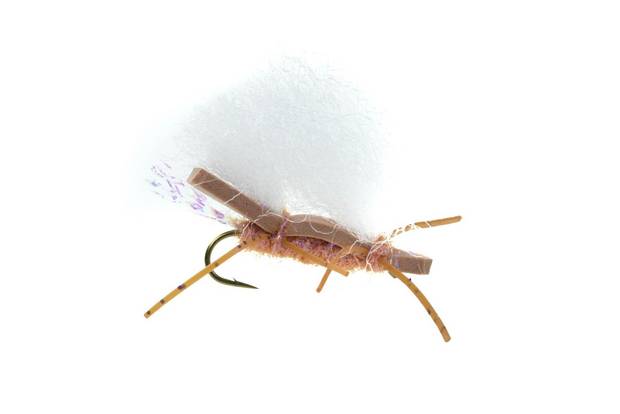
Chubby Chernobyl
Foam and rubber legs and Antron, oh, my! It’s hard to believe that this was once a “fringe” fly — snubbed by fly purists as a kitschy fad. But, hey, foam floats. Hoppers float. And, as it turns out, trout eat both. The Chernobyl was first tied to imitate an ant by guides on Utah’s Green River sometime in the late 1980s or early 1990s (I know, right? It’s been that long?).
Over the years more foam, more rubber legs and more Antron have been stacked upon this dependable floater, so much so that I would wager, more often than not, that it’s used as an indicator more than it is to actually catch trout. Except for the next six weeks or, that is. It’s a trout-getter during terrestrial season, and I won’t leave home without half a dozen in my box.
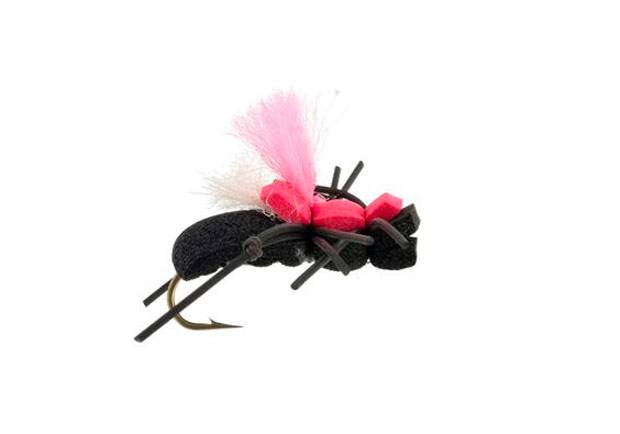
Fat Albert
It’s not unlike the Chubby. It has, you guessed it, more foam. Usually tied with at least two layers of foam, some iterations have a bright tag on top that makes it easy for anglers to see. I do think the Fat Albert is more versatile than its foam buddy, though. I spent a magical evening on the Rio Malleo in Argentina skating these big bugs over likely runs just at dusk — and was rewarded with several very nice trout. This terrestrial imitater was first tied by Brent Taylor of Missouri, and like its irradiated cousin, it’s often used as an indicator. But, again, it’s hopper time. And, in all honesty, I think the Fat Albert better resembles a hopper than does a Chernobyl.
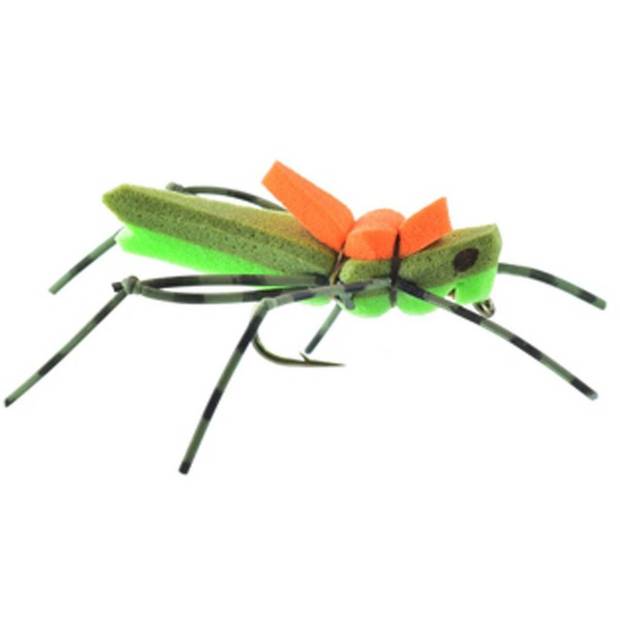
Morrish Hopper
This one actually looks like a hopper, which is a nice change from impressionistic offerings above. It’s shaped like a hopper, it floats like a hopper, and it can be tied in all kinds of muted colors to resemble local terrestrials. On rivers in the American West, this is an absolute sure-fire fly during hopper season. It’s my go-to on the South Fork of the Snake — thrown with vigor up against the banks, it’s not uncommon to see more than one big trout rise in the water column to gobble it up. This fly was first tied by Ken Morrish, who grew up fishing the rivers of Northern California, where summer can be miserably hot, but also where spring-creek trout let their guard down a bit when the big bugs are out.
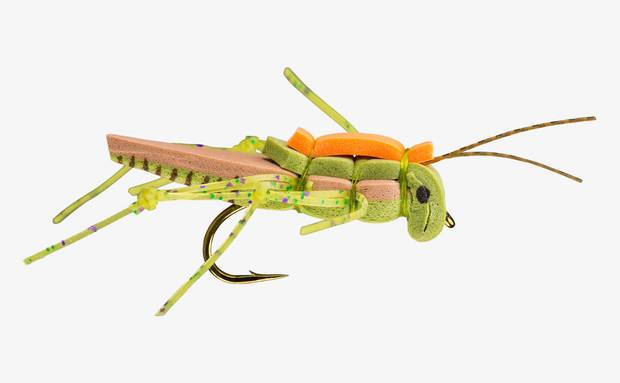
RIO’s Juicy Hopper
Like the Morrish Hopper, RIO’s Juicy Hopper is a bit more like a hopper than a Chubby or a Fat Albert, but only from a silhouette perspective. These gaudy flies are usually tied in pink, and some versions incorporate four — count ‘em, four! — layers of foam. Like the Morrish Hopper, this is a western trout getter. RIO markets the flies tied in various shades, but the consistent marker is the bright orange flag of foam atop the bug. This fly, if you take care to dust it now and then, will literally last you all day and never sink on you. It’s another great choice for rivers in the West, but, tied in smaller sizes, it’s also a great backcountry attractor — I’ve enjoyed many days on small, out-of-the-way brook trout streams casting this pattern in late summer, and sometimes-diminutive wild trout dig it, too.
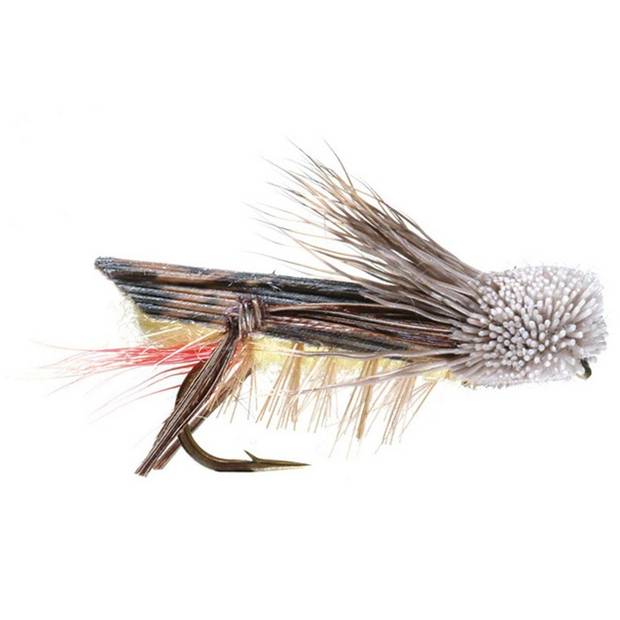
Dave’s Hopper
It just feels wrong to leave out at least one traditional hopper pattern, so Dave Whitlock’s offering makes the cut. In its traditional form, it’s tied with spun deer hair and a chorded Antron body — the color is up to the angler at the vise. Later versions substitute the Antron for, you guessed it, craft foam. No matter. It’s always worked. And … it always will. Whitlock first tied this bug in Oklahoma in the 1950s, so it’s definitely a “legacy” pattern. I love that it depends on the spun deer hair tying method — with foam seemingly showing up in just about every dry-fly pattern of late, I fear that spinning hair is becoming a lost art, at least among those who tie trout flies. I can’t really blame them. Spinning hair is tough for a lot of folks, and it takes practice and patience, but the results are visually stunning … and very buoyant.
There are literally dozens of hopper patterns to choose from, and most are tied in size 10 or bigger. Don’t shy away from these big bugs, especially now, when it’s hot and streamside grass is belly high to a moose.












Comments
Anonymous replied on Permalink
What, no Charlie Boy?
Charlie Craven has one of the best tying techniques for producing a realistic foam bodied hopper. If you like to tie, it is a must try.
t-mac replied on Permalink
I've never used a hopper that looks like Dave's. When I see them in a fly shop they look less durable than their foam counterparts, am I right in thinking this? Thanks for any help.
Chuck Stranahan replied on Permalink
Fish 'em.
The wings will tatter and the deer hair head will get scraggly. They'll get waterlogged and sink and every ten fish or so, need to be replaced.
But they'll keep catching fish.
If a fish comes to a Dave's Hopper it'll take it, unless something else is wrong. Get the cast in, make it move like a real hopper, and the sure, deliberate takes will come.
Foam lasts longer and keeps on floating. I'll give it that.
Let's break it down further: A chubby-style fly will draw a lot of splashy refusals and catch some fish. It keeps things exciting but all that splashing belies the fact that by comparison to other patterns, it isn't that productive - especially over heavily fished fish.
Casting any chubby-style fly is like trying to cast a foul-hooked hummingbird. Sometimes you need to get the cast in. A Chubby works against that. Really, a Chubby is a big attractor and that's all. It's not a hopper.
A flat-silhouette foam fly casts easier through wind. Now we're getting warm... a foam fly that has a hopper-like silhouette, can be put at the edge of a windblown seam where trout line up to eat windblown hoppers.? Still, there are drawbacks.
One Catch-22 is that a Dave's or a Schroeder's, to name two, will hit the water with the same splat as a natural. That natural descent will trigger immediate strikes - and I've seen the unnatural splash of foam flies put fish down.
Why not keep that advantage even if you're not fishing over picky fish? You might catch the one that is, and it might be fish of the day.
Foam attractors work even if they don't look like hoppers. A couple of flies on the author's list look like beetles or maybe stoneflies - or more simply, a big mouthful of something a trout might decide to eat - and we don't know what goes on in the pea-sized brain of a trout.
But if I want to catch fish when hoppers are being blown into the water and a row of big rainbows or browns are lined up on the wind seam and keying on them, I'll start with a fly that checks all the boxes: castable, hopper-like descent and splat, can be moved like a hopper on the water, hopper-like silhouette and legs that look and move like hopper legs, fly tied from proven fish-catching materials, easy to see, and durable: Ed Schroeder's Parachute Hopper.
Still the best - and deserving of a place on the list.
Rick B replied on Permalink
Well said! One of the more thoughtful (and truthful) posts I’ve read in a long time.
I really appreciated your comments on hopper “SPLAT!”
If you want your foam “hoppers” to achieve that same, natural splat that triggers a lateral line response, try an underbody of 0.010 or 0.015 lead. My leadbelly hoppers and leadbelly (foam) beetles produce a perfect “PLOP” without having to alter the standard fly cast.
Rick B replied on Permalink
Unweighted foam hoppers also float unnaturally high on the surface, as opposed to Joe’s hoppers that has a much more natural posture.
If you can’t give up the foam, think about adding some lead to fat the perfect splat and more realistic posture in the surface film.
John Gustafson replied on Permalink
Paul Stimpson’s Klod Hopper pattern in Al and Gretchen Beatty’s book has remained my favorite pattern for 15 years. It still works, even when the guide wants me to use pink or purple colors. The more it is chewed and shredded, the better. Worth searching out or tying up.
Kerry Gubits replied on Permalink
I spent many many years fishing the Joe's Hopper on the Arkansas in Colorado, where the fish would rocket from the bottom of Brown's Canyon to inhale them. My Joe's was the one pattern that gotten eaten consistently all over the West, from the Green to the Bighorn. Nothing actually looks like a grasshopper more than Joe's. And the fish know it.
Pages