
I knew he’d be trouble from the moment I saw him. He was a big guy, top-heavy, lumbering down the stairs from the jet. I stood off to the side, unnoticed, as he and the others—mostly Argentines—ambled toward the small stone building that, in 1985, served as the airport terminal for San Martín de los Andes. There was a stark disconnect between the tiny, tin-roofed hut with its small stone chimney and the large modern jet looming over it. The hand-pulled baggage cart, piled high, somehow bridged the gap.
It was my first season in Argentina, and after months of nonstop guiding, I had begun to see exchange days as my time off. I learned to recharge in those brief moments between saying goodbye to one set of clients and picking up the next. I stood with my eyes closed, letting the wind wash over my face.
Jorge had called it a “puelche.” Unlike the usual weather that came from the mountains at my back, this wind came off the desert to the east and was said to be a harbinger of difficult fishing.
I opened my eyes and moved toward the luggage cart. I had given myself more time than I should have; my sport would have found his bags by now and be looking for his gringo guide.
“Hi, my name’s Bob,” I said, reaching out my hand. “I’ll be your guide this week.”
My eyes drifted from his face to his enormous belt buckle. It was shaped like Texas and as big as a pie tin. I imagined Matamoros made it plenty uncomfortable to sit down.
“Well, shitfire, Bobby!” he replied in a thick accent. “It’s mighty nice to finally meet another American. My name’s Ford!”
His hands were as big as hams and I wondered how I’d ever cast again after he released his grip. We identified his bags and tossed them into the back of the pickup I’d been issued for the week. Since he was a single angler, I wouldn’t need the extra passenger space.
“Y’all got any cervezas in that cooler?” he asked half an hour later as we rolled through the dusty little town of Junín.
“Yes, sir—sorry I hadn’t thought of that sooner,” I replied, pulling off the road after we crossed the Chimehuín River. I reached into the box and pulled out a large, brown bottle of Schneider. It was cold and beaded with condensation. I popped the cap with the back of my knife, as I’d been taught.
“Y’all got any Budweiser?”
He finished the first beer and had another in hand before I turned onto the gravel track leading over Paso Santa Julia and, eventually, to San Huberto, where we’d fish for the next few days.
After a quick lunch, the sport retreated to his room to sort out his gear. He returned wearing a T-shirt with large block letters across the front: I FISH ALONE. As he walked past, I read the back: LEAVE ME ALONE.
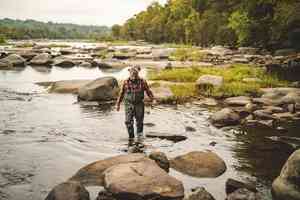
As was customary, we wadered up on the porch—me in my Red Ball Rangers, him in 5mm camouflage boot-foot neoprenes—and headed to the river. It was late February, and the hopper fishing had been especially good on a stretch we called La Chacra, where the Malleo made a long, sweeping bend through a hayfield. It would be a good place to get him into fish, get a sense of his style, and evaluate his abilities. That would help me plan the rest of the week.
“Let’s take a peek over the edge and see what we have,” I whispered, dropping to my knees and crawling forward. I slowly raised my head above the waist-high grass.
Half a dozen good fish, happily rising, vanished into the depths as my sport thundered past.
“Boy howdy, these waders are hot!” he announced.
By the time we walked upriver to the vado, where we’d cross, he had spooked another dozen fish. I figured they’d settle and resume feeding by the time we actually started fishing.
I was right.
“Watch that eddy along the high bank, behind the willow, while I get us ready,” I said.
I rigged his rod, built a leader, attached 4X tippet, tied on a Dave’s Hopper, sharpened the hook, and checked the knots. We were ready.
A long shadow had fallen across the water, allowing us to get closer than I usually liked. He stripped line from his reel and flipped the fly behind him onto the water. So far, so good. Maybe this guy would work out after all.
“There’s nothing behind you to worry about,” I coached. “Let him rise once more so you know where he’s feeding. There,” I said, pointing my rod at the rise form, “drop it a few feet above him. Don’t worry if it lands hard—sometimes that triggers a strike. Be ready.”
The fish rose again. The sport rolled out a short line to find his direction, one more for distance, then made a perfect cast. I felt hopeful.
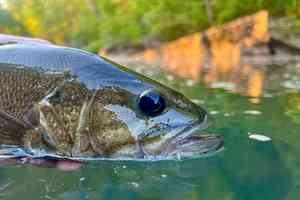
The fly brushed a willow leaf as the tippet rolled out, hung for an instant, then fell gently—perfectly—onto the water. I held my breath as the hopper drifted over the big brown. It tipped up and sipped the fly with quiet confidence.
“Now,” I whispered.
“FISH ON!” he shouted, snapping the rod back like a rapier strike.
There was a crack so loud I thought the rod had exploded.
“Shit,” I said. Then, more gently, “That might have been a bit too hard.”
“Hell’s bells, Bobby! What am I using for tippet?”
“4X,” I replied.
“Well, shit, boy, I use 0X for the bass in my stock ponds back home—and that works just fine!”
“0X?”
“Hell yeah, 0X… and I never lose a fish!”
“Sixteen-pound tippet… with a hopper?”
“Tie on some 0X, Bobby—and let’s get to fishing!”
I cut back the leader, added a length of 0X, and finally found a hopper with an eye big enough to thread it. The knot was larger than some midges I fish.
We found another rising fish, set up, made a decent cast—and got a refusal. The next cast spooked it. This pattern repeated a dozen times until the sun dropped off the water and an early spinner fall began. The fish responded and started rising again.
“What are they eatin’, Bobby?”
“Spinners,” I said. “But the flies are much smaller—and we should use 5X, maybe even 6X.”
“Well, shit.”
“Sorry, but there’s no way I can thread 0X through a spinner.”
“Will 4X work?”
“Maybe.”
“Okay… I’ll do 4X—but only if I have to.”
“Deal.”
Most of the fish refused our flies on 4X, but we did get a few takes. Each time, the excited shout of “FISH ON!” was followed by another break-off—or a straightened hook.
I was willing to keep at it, to try to coach him into a gentler hook set, but he called it a day. We drove back to the lodge in a long, heavy silence.
We arrived just as a new group of anglers came in, buzzing with excitement. They were hosted by Lefty Kreh, whom I recognized and revered, though we’d never met. Someone asked my sport how he’d done.
“Well, we had plenty of chances,” he announced loudly, “but my guide insisted on using 4X tippet, and I broke off every fish.”
I was mortified. Heads turned from him to me and back again. Lefty caught my eye and seemed to read my discomfort. He smiled.
“Hmmm,” he said to the sport. “This your rod?”
“Yup.”
“Same tippet?”
“Yup.”
Lefty plucked a #12 Royal Wulff from his hat and tied it on.
“4X, you say?”
“Yup.”
“Well now,” he said, with everyone watching, “I’m going to hook this fly to that fence post, and I want you to break it off with a hook set.”
My stomach dropped as he handed the rod back and walked the fly over to the post, the reel clicking with each step. I wanted to disappear.
“There,” Lefty said, securing the fly. “Now, break it off.”
The sport reared back like he was swinging for the fences, but Lefty put a hand on his shoulder.
“No—just set the hook regular-like. Lift the rod until the line comes tight, and let the rod do the work.”
The sport did as he was told, lifting gently. The rod bent deeply. The tippet held.
He looked confused. The crowd chuckled.
Lefty looked straight at me and said, loud enough for everyone to hear, “I don’t think it was the tippet… or the guide.”
I had finally met Lefty.





Comments
Steven replied on Permalink
He was still fishing for bass in his mind in his stockpond back home.
Anonymous replied on Permalink
Nicely written Bob!
Michael Courtney replied on Permalink
Great writing, you unfolded the story very well.
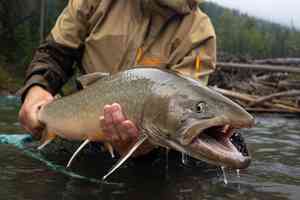
And the illustration is superb.
Pages