
This year’s Columbia and Snake river steelhead run is shaping up to be historically bad. Since the fish counting at Bonneville Dam started only July 1, fisheries managers have tallied just over 52,000 fish above the dam. This makes the 2026 steelhead migration the smallest ever recorded.
So far, the run is averaging about 43,000 fewer fish than the 10-year average, and the run is a fraction of the 2025 run. Last year, by this time, managers logged more than 128,000 fish above Bonneville Dam. In response, fisheries managers in both Washington and Idaho have reduced the steelhead harvest for anglers in both states. In Oregon, fisheries managers closed both the Deschutes and John Day Rivers to steelhead fishing for the entire 2026 season after steelhead return counts at Bonneville Dam failed to meet minimum benchmarks.
In Washington, the limit in the Snake River from its confluence with the Columbia to Lower Granite Dam will drop from three hatchery fish to one (hatchery fish have a clipped adipose fin — unclipped fish are considered wild and must be returned to the river immediately). Above Lower Granite Dam the limit will be two hatchery fish. In response to the latest data, Idaho Fish and Game reduced the statewide limit to two fish per day, and, on the Clearwater and its open tributaries, anglers can only keep one hatchery fish over 28 inches. The normal daily harvest in Idaho, starting Sept. 1 each year, is three fish.
After the most recent data became available, fisheries managers adjusted the run’s total forecast down to 61,500 fish, which would make this year’s steelhead run the worst since Bonneville Dam was built in 1938.
According to Idaho Fish and Game, one of the biggest reasons this year’s run is historically bad is because the run’s “two-ocean fish” — steelhead that spend two full years at sea before returning to spawn — is substantially below the forecast put out by fisheries managers prior to the migration. Every year, spawning runs are boosted by either one-ocean fish (one year at sea) or the two-ocean fish. “The two-ocean component was expected to provide a much stronger return and instead is returning substantially below expectations,” a statement from IDFG in response to the poor return reads.
Also, according to Fish and Game, the hatchery production and juvenile survival rate for this run of fish was considered normal by fisheries managers when smolts were released in the spring of 2024. Smolt releases were normal, and the survival rate of the smolts migrating to Lower Granite Dam was 75 percent (the 10-year average is 77 percent).
Once the smolts reach the ocean, however, their survival becomes much more challenging to determine. There are more factors to consider once the fish reach the sea — water temperature, forage base, upwelling, predation, etc. That said, nearshore monitoring as the 2024 run hit the salt delivered mixed results. Steelhead, though, tend to migrate offshore very quickly, and then they become almost impossible to monitor, saving for the few that turn up in nets or end up caught by ocean anglers.
“The fact that preseason forecasts substantially overestimated this year’s return reinforces how much uncertainty remains in the ocean. No single freshwater, hydrosystem, or ocean indicator currently provides a complete explanation for what appears to be one of the poorest steelhead returns in modern history,” the statement reads. “Because of this, fisheries managers and anglers are stuck waiting for the initial adult returns to Bonneville to start making real inferences about run strengths.”
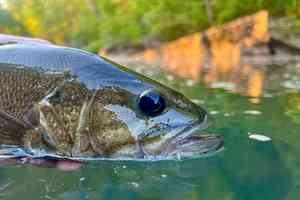
Of course, the elephant in the room is the eight dams steelhead must navigate, both downstream to the ocean and then upstream to their spawning habitat in the upper Columbia and Snake River drainages. While all eight dams are equipped with fish passage, they all likely take a bite out of the annual migration. All eight dams back up the Snake or the Columbia and create slow-water reservoirs behind them. These slackwaters that used to flow freely to the sea are now home to a host of predatory invasive species ranging from smallmouth bass and walleye, to carp and northern pike. The lower dams create bottlenecks for fish migrating upriver, and everything from seals and sea lions to turns and raptors get a shot at the fish as they swim home to spawn.
Of note: in its statement, Idaho Fish and Game does not mention the dams as being sources of potential steelhead mortality. According to Wild Steelheaders United, an arm of Trout Unlimited, each dam on the lower Snake River reduces juvenile salmon survival by 25 percent — it’s not a leap in logic to suspect that the same is true for the river’s steelhead.
If there’s a silver lining to this year’s miserable run, it’s this: with this migration largely supported by two-ocean fish, the fish that do make it home to spawn in the upper Snake River drainage are likely to be bigger fish. And bigger female steelhead produce more eggs.
Of course, that also means that one-ocean fish aren’t filling in the gaps. Or, as Chris Donley, eastern region fish program manager for Washington Department of Fish and Wildlife, put it in the Sept. 15 issue of the Spokesman-Review, “the one-ocean cohort is completely missing, and, typically, they’re the most abundant.”






















Comments