
Spoiled. Rotten.
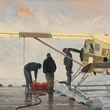
There’s no other reasonable way to describe the feeling that washed over me as Andre Lafferma guided the metallic blue Bell Jet Ranger II helicopter off the gravel bar, elevated into the cold, gray sky, and disappeared into the rain-blurred ether. Light three passengers and some fly-fishing gear, the chopper climbed to the lip of the river canyon, topped the spruce and cedar trees that reached to the slate-gray heavens, and, just like that, we were alone on a remote, emerald-green river somewhere in British Columbia’s Cariboo Mountains.
Ken Bibby, our guide for the day, zipped his rain jacket up to his chin.
“It’s a wader day,” he said. July in south-central BC can be downright gorgeous, and wet wading is hardly discouraged by guides like Ken. But today, with a sideways squall blowing through and morning temperatures dipping dangerously close to freezing, the waders were necessary. “I hate wader days.”
Me, too, Ken.
More Like This
But I knew what we were getting into. The Cariboos are situated in an inland rainforest. The rain was expected. Even welcomed, actually. A spate of warm, dry weather the first week of July had Ken a bit concerned that a prized local fishery with a cult-like following might not go off as planned. But the weather veered back toward “normal” just as we arrived, and the rivers came up a bit to welcome one of the region’s most-prized migrants: giant bull trout. And you don’t chase big bull trout on cold, rainy days in a pair or quick-dry shorts and some cleated river shoes.
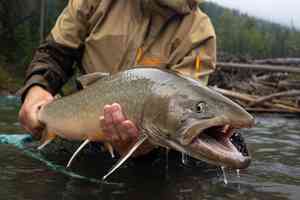
These native char are, in my estimation, the most misunderstood game fish in North America. Their range extends from the extreme northern reaches of Nevada in the Snake River drainage and continues north, well into the Yukon Territory and the Liard River drainage. Bull trout are surly, ill-tempered, and perfectly geared toward an existence in coldest waters of the northern Rockies and their offshoot ranges, like the Cariboos that rise west and north of Jasper, Alberta. These hefty fish — and that’s the ideal adjective for them — migrate up the big rivers of southern BC every summer enroute to their natal spawning waters in the impossibly clear waters of the high country. They push up rivers like the Fraser, the Okanagan, the Kootenai, and the Columbia, leaving their winter and spring homes in downstream lakes and the deep, slow reaches of these fabled western waters.
Bull trout are true predators. Piscivores. Certainly, when they're small, they’ll survive on typical trout fare — aquatic insects, worms, terrestrial bugs, and the like. But as they mature, and settle into their “grownup” homes, the big-bodied char chase other prey, like whitefish, sculpins, and salmon and steelhead smolt. And, as Ken happily pointed out as we approached the first run of the first day on the water, “they’ll explode under a skated mouse.”
Mostly, though, he said, they’ll chase ridiculously long streamer patterns stripped maniacally through deep jade-tinged pools. If you’re lucky, you can be there to meet these fish when they are showing up on their pre-spawn runs up the rivers and streams of the inland mountains. Or, as I noted earlier, if you’re spoiled rotten, like we were.
The only way to fly
I’m no snob. For most of my trout-fishing days, I’ve traveled to the water in a pickup truck, happily slept on an air mattress in a tent or, during the salad days of my 40s, on a cozy bunk in a small camper. And I was just fine heating up a can of beans over a fire, and guzzling scalded percolator coffee.
So, as Andre disappeared into the rainy Canadian skies, I was quick to take stock. On any other day, if I wanted to find myself on this particular gravel bar on this very river at this exact moment, I would have had to have hiked in the night before and braved the gnarly, wet weather. I would have slept in an all-weather sleeping bag tucked into a small tent, and I might have rehydrated some barfy powdered eggs, assuming I remembered the Jet-boil and could keep it going in the rain.
Instead, my belly was full of a delightful helping of Eggs Benedict, fresh cappuccino, and half a carafe of freshly squeezed OJ. I slept soundly the night before in a spacious queen-sized bed beneath the timbers of the gorgeous Crescent Spur Lodge tucked into the Fraser River bottoms, my home base for the next four nights. The previous evening, my fishing buddy and I drained two bottles of Malbec, enjoyed a perfect, medium-rare New York strip prepared by the lodge’s veteran chef, and topped off the evening with a toast of Jameson poured over two crystalline globes of ice.
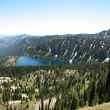
Then, just 30 minutes or so earlier, I plopped into the back seat of the chopper, admired the low clouds over the rainforest and found myself deposited here, on this stunning mountain creek at the lip of what might be the most perfect stretch of bull trout water I’d ever seen.

“Let’s see if we can find some fish,” Ken said, looking out over the deep, green pool of the creek. “It looks perfect.”
As I started assembling my fly rod on this lonely gravel bar in the middle of nowhere, I heard Ken speaking into a handheld radio he kept tucked into his rain jacket.
“We’ll give these first couple of runs a quick look,” he said, gazing out over the slightly milky and rain-swollen creek. “I’ll give you a shout in about half an hour and let you know if we need a bump.”
The radio squelched, and I heard Andre’s quick reply. “Ten-four. I’m taking the other couple over the hill. I’ll be ready in 30 if you need me. Out.”
A bump? I looked at Ken with what must have been a quizzical expression on my face.
“If they’re not here,” he said, waving his arm out over the water, referencing the migratory bull trout we were hunting for, “I’ll call him. He’ll come get us, and we’ll try a new spot.”
I nodded, as if I fully comprehended just how nuanced this situation really was, and what a luxury it was to have a nimble helicopter and its able pilot, virtually at our beck and call, to take us somewhere else should we strike out.
It happens fast
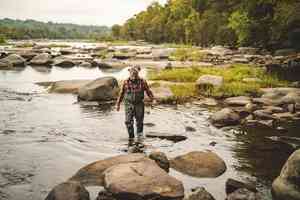
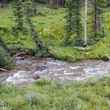
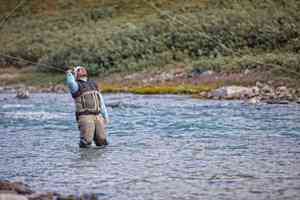
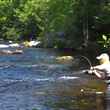
I stood at the lip of a long run, where this beautiful backcountry stream tops a gravel flat and then spills out over a deep scour pool. The deep water continues downstream for a good 100 meters or so before it slicks out and slows down a bit. Along its way, the stream pinches between a set of Camry-sized boulders on the far side, and a mishmash of fallen three trunks and woody debris deposited there by spring runoff. By any streamer angler’s barometer, the run was downright erogenous. Then, below this run, a second, very similar length of water stretches out another couple hundred meters. I couldn’t imagine a better place to start fishing.
“With the water up a bit, they should be here,” Ken said. He explained that, as we flew over this two-run stretch of swing-fishing heaven on the chopper flight in, he couldn’t see any fish, but, because the water was just a bit stained, that didn’t discourage him. Even on days when the rivers and streams of the Cariboos are perfectly clear, bull trout are hard to see, particularly early in the run, when their olive-tinged frames look like just about any other rock on the riverbottom.
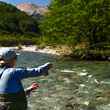
Ken had me tie a dark green articulated Dolly Llama to my 2x tippet, and I dunked the fly to gauge just how fast it got down. The heavy streamer audibly plopped into the river at my feet and was resting on the gravel in front of my wading boots before I could even begin to count. I nodded appreciatively. The fly should fight through the froth and dive into “the zone” without a lot of effort. So, I started to strip some fly line off of my 7-weight reel and prep for my first cast. The idea was to put the big fly downstream and across from my position and let it swing to the middle, where I’d begin my strip.
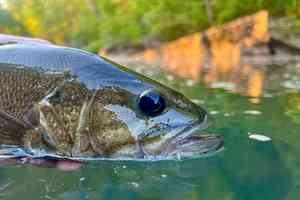
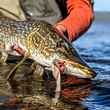
In practice, it was a good plan. In reality, I quickly learned, I was overthinking it. As I stripped it out, some of the coated nylon fly line caught the current, which lifted the leader, tippet, and the burly fly from the river bottom, all while I was looking out over the water and trying to determine the fly’s eventual “landing zone.” The fly, unbeknownst to me, was fluttering in the current not 10 feet downstream, and, as I lifted my rod to make my first cast, the river exploded in front of me. A 28-inch bull trout was in no mood to wait for my cast — it screamed into the current at the head of the pool and absolutely smashed the streamer.
“Well,” Ken said through a sheepish grin, “I think it’s safe to say they’re here.” My first bull trout of the trip didn’t require a single cast.
When ‘they’re here,’ they're here
I think the best way to describe bull trout fishing is that it can be either a feast or a famine. As Ken noted, when “they’re here,” they’re not the most challenging fish in the river. In fact, Ken said, when the bulls have congregated in any given pool, riffle, or hole, most other fish in the river get the heck out. That means anglers aren’t likely to catch any rainbows (although they, too, call the rivers of the Cariboos home) or any whitefish. Bull trout don’t lose perspective like salmon or steelhead — they eat the entire length of their migration, and I’d wager that they eat as they move back down to their big-water homes as winter sets in.
But, when they’re not where you’re fishing, there’s no sense sticking with it. Hence the value of the helicopter “bumps.”
“If they’re in the holding water, it’s very rare for them to not eat,” Ken said. “They are opportunists. If they see something that looks like food, they’ll eat it.”
And this is where confidence comes in. During a migration that might start in early July and continue into September, bull trout guides face an interesting conundrum. With the understanding that finding the fish is the single-most important factor in the overall effort to catch them, a guide might choose a fly pattern that improves the chances for success. That’s where the big, swimmy Dolly Llama came in.
But, on that first run, when the first bull trout was eager enough to nail the streamer just fluttering in the current, Ken openly regretted the fly call.
“Honestly, Chris,” he said, “we should have started with the mouse. A fish eager enough to hit a streamer that wasn’t even cast would have definitely taken the mouse.”
Over the course of the next few days, we encountered more eager fish. And I tried a big, floating Moorish Mouse a few times, with Ken’s hearty encouragement. The results? Three solid takes, but no hookups — the cost you pay for playing with fly-fishing fire, I guess.
And no, not every day was like that first pool on that first day. At times, we discovered, some of the most fishy water we could find was devoid of bulls. On other waters, we’d find them stacked up in a deep run, and we’d take turns catching one massive char after another until we just wore them down. Then, we’d move upstream to the next gorgeous pool, and … nothing. If finding the fish is the most important factor, being nimble is the next requirement. And that means anglers with a helicopter at their disposal have it made. The “spoiled rotten” comments stands.

Big water, big bulls
While I love the jade pools, and the rush of the cold, backcountry rivers that slice through the lush forests of southern BC, the best fishing for truly big bull trout while we visited the area happened as the smaller waters met the big rivers. The transition zone where silt-laden glacial flows met the emerald-green waters of the tributaries rarely let us down.
“As bull trout move upriver, they like to find these pockets of clear water where they can rest and recharge,” Ken explained. Even if the fish aren’t destined to push into a given tributary, he explained, they’ll move into those transition waters because they’re colder and, often, that’s where the food is. So, a few times over the course of our four days on the water, Andre dropped us off in what initially looked like marginal habitat — silty, featureless water above or below a creek mouth — and we found very large bull trout, including a few over 30 inches long, hanging on the fringes where the two water types meet.
As Ken instructed, and in line with a generally accepted fly-fishing rule of thumb, we made an effort to fish where it got dirty. And it proved to be a very productive plan, particularly when we were struggling to find fish in otherwise gorgeous water in the canyon reaches of the tributaries, well away from the valley bottom.
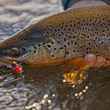
In fact, the biggest bull trout we hooked and landed actually came from the Fraser River — the 33-inch migrating fish was upstream of a stunning mountain creek that dumps into the silty river, where the fresh, clean flows of the little creek create something of a cushion of cold, green water. For an hour one afternoon, we watched as big bulls would appear out of the muck and grab streamers as we stripped them along the edges where the silty water eventually supplants the clear water. I’d switched over to a smaller, white rabbit-strip streamer that was quite a bit easier to cast than a water-logged Dolly Llama, and the big fish followed it right to my feet before grabbing it and sprinting off into the silty waters of the Fraser.
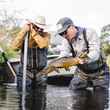
“That’s a big one,” Ken said, dropping off the grassy bank of the big river and stepping into the water, net in hand. I got the fish close, and Ken’s eyes got big. “Yeah. That’s a really big one.”
Final word
Where I live in Idaho, bull trout aren’t all that uncommon, but they require serious effort — boot leather, tire rubber, maps with notes in the margins, and no small amount of luck. The chance to visit southern BC and actively target these menacing char and have the helicopter generally at our disposal while doing so is likely something I’ll get to do just once. With that in mind, there was no way I was going to pass on this chance. The flights, in addition to being very utilitarian and incredibly functional for anglers on the prowl for bulls, offered a stunning view of the inland rainforests of southern BC. The opportunity to fish several post-card-perfect mountain waters and take in the beauty of the area’s remote backcountry was something I’ll never forget.
And, let’s face it. I like being spoiled. Spoiled rotten.
If you go
Getting There
A visit to southern BC’s bull trout waters requires a bit of effort. It’s possible to drive, but it’s a haul from all points south, and it’s at least a full day’s drive east of Vancouver. If you can, a flight from Vancouver to Prince George cuts down on the travel time, and, if you’re a guest at Crescent Spur Lodge, you’ll be shuttled directly from the airport to the lodge and deposited in the literal lap of luxury.
When to go
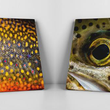
The bull trout migration in southern BC starts in earnest in July and continues into September. Later in the summer, the bull trout, like all char, color up a bit and display creamy white fins and bright orange spots. It’s best to pursue these fish between July 15 and the end of August to avoid fishing for them when they’re actually spawning.
Choosing an outfitter
There are several fishing outfitters and lodges in and around Prince George, but only Crescent Spur Lodge devotes its efforts to chasing bull trout in the wild waters of the Cariboos. The lodge operates as a heli-skiing operation in the winter, but during the gorgeous British Columibia summer, Crescent Spur turns its focus on the bull that migrate into the Cariboos on their annual spawning run.







Comments
Chad replied on Permalink
Come back up to Prince George and I'll hook you up on a mouse. You haven't even tasted the best bull trout waters yet.
Chris Hunt replied on Permalink
I can't wait to get back up that way. Absolutely gorgeous rivers. Y'all are truly fortunate to have all that great water and fishing. Thanks for sharing it with me for a few short days!
Pages